What it is
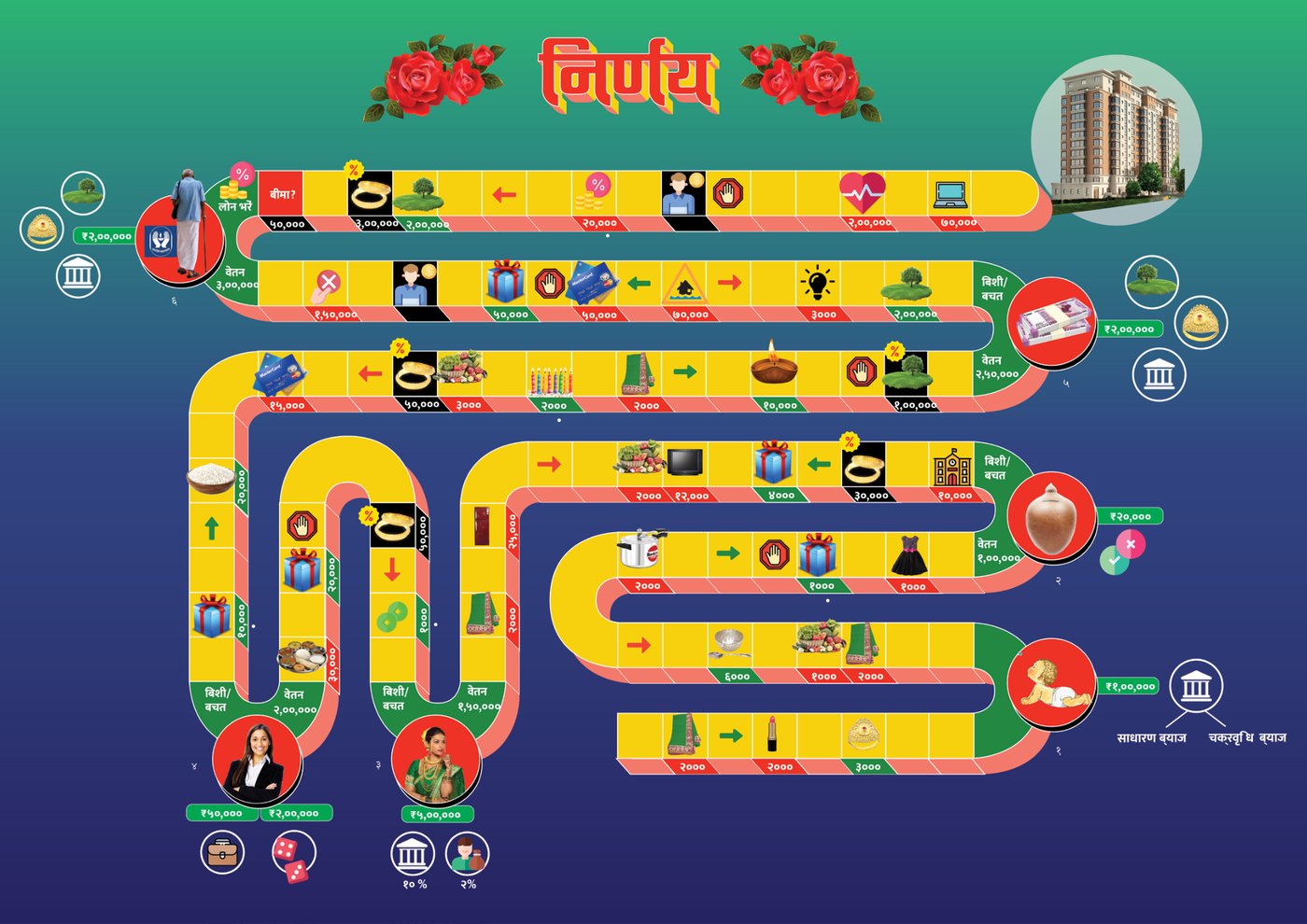
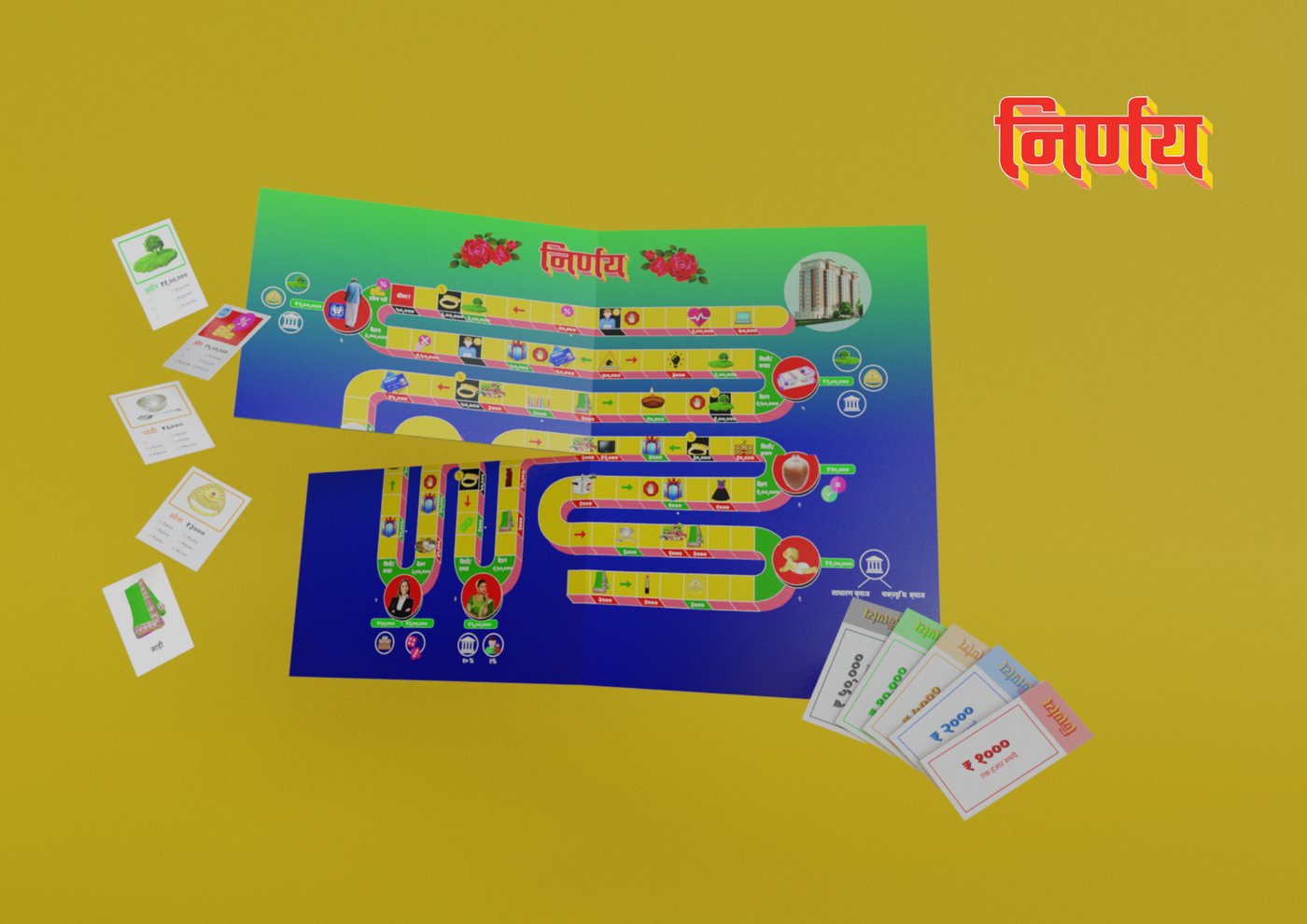
Nirnay (Hindi for "decision") is a one-hour board game in Hindi for three or four players, run by an NGO facilitator as Game Master. Players move along a winding life timeline from schooling to retirement, earn and spend, and at six red decision points face the financial choices that low-literate women in Pune's chawls told me they actually face. I designed it as my M.Des thesis at IDC, IIT Bombay, with Deep Griha Society, between January and June 2021, guided by Prof. Girish Dalvi. It was printed, and playtested with three women who had never played a board game before.
The frame
Decision 1: Build for play, not for behaviour change
The obvious thesis was a product that changes how these women save and spend. I decided against it, and the decision shaped everything after.
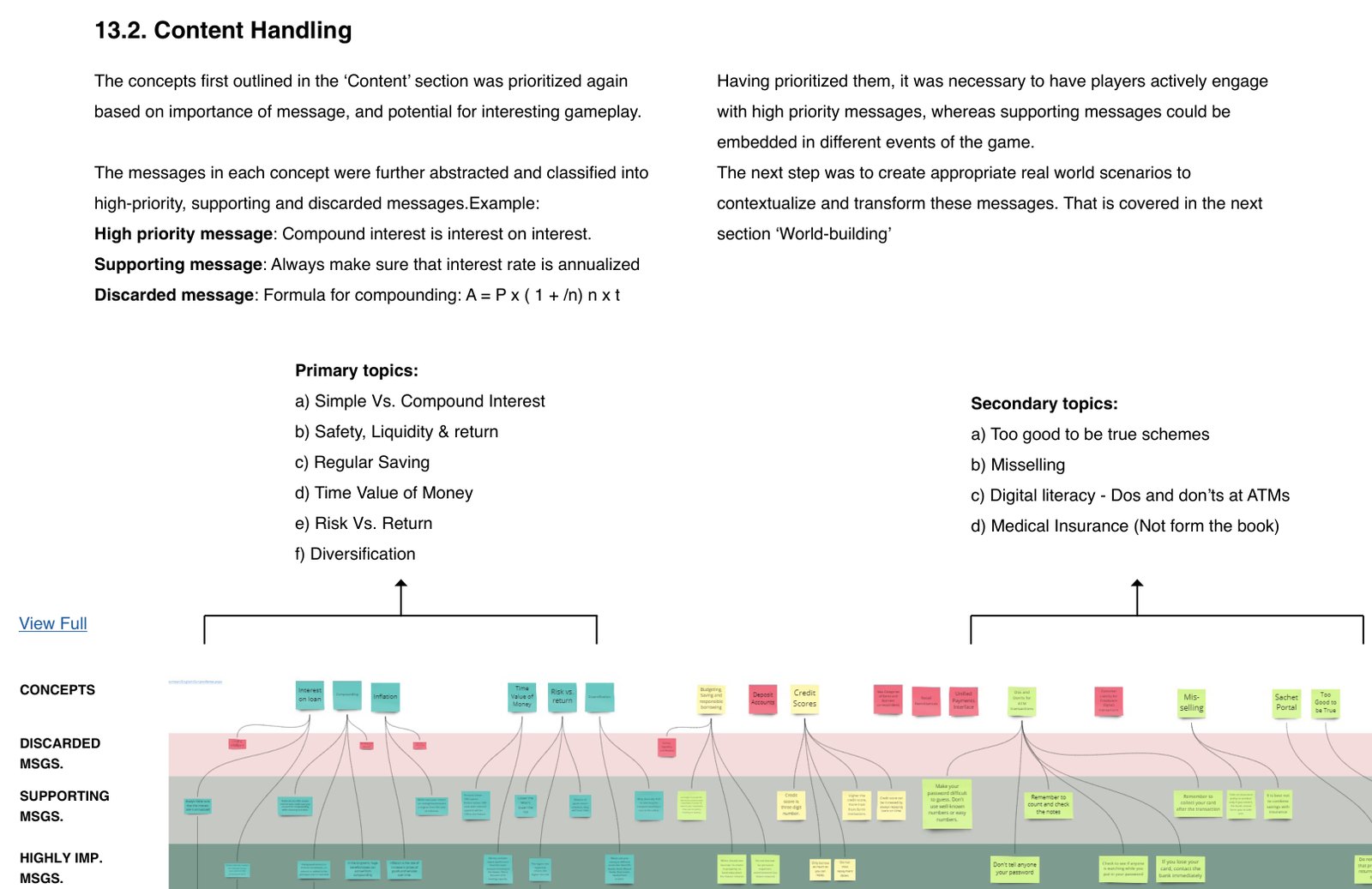
The Phase I jury and a content expert forced the sharpening. The jury: "You're assuming users are clean slates"; define the baseline; name the behaviours; state the learning outcomes. And a provocation I could not answer: "Are you financially literate? How can you decide the level of 'financial literacy' for an M.Des student versus a domestic worker?" The expert: drop the phrase "financial literacy", pick one commonly misunderstood concept and gamify that. So I stopped claiming literacy and named six things from the RBI's Financial Awareness Messages handbook: interest on a loan, compounding, inflation, time value of money, risk versus return, diversification.
One limitation earned its place here. I was a finance novice, which slowed the content work and also made me a fair proxy for players who found finance intimidating. What confused me went into the discarded pile.
Decision 2: Make the board a life, not a metaphor
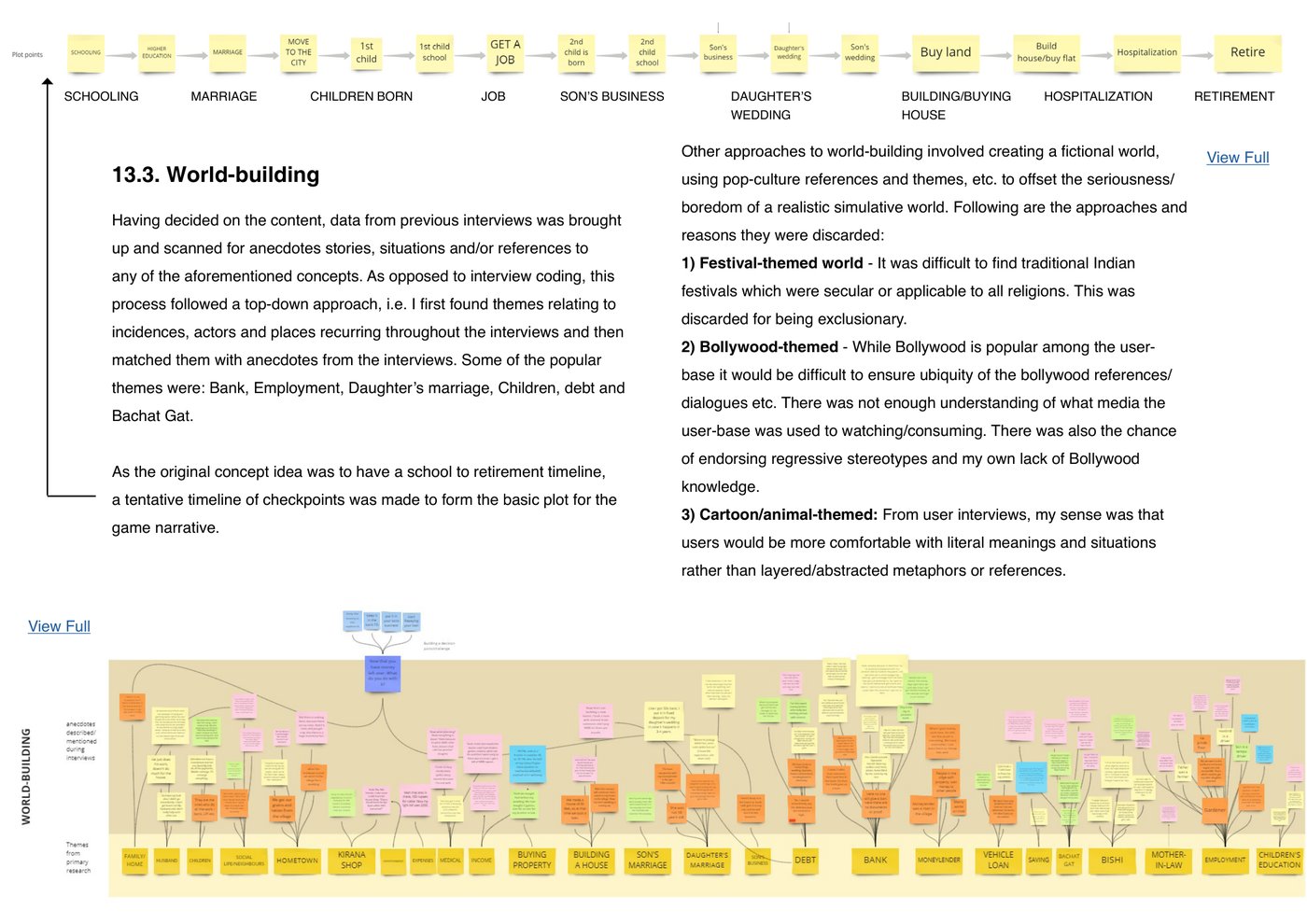
I chose a literal life timeline over every themed world I tried, because the interviews said literal meanings land and layered metaphors don't.
- Schooling
- Marriage
- Children
- Job
- Son's business
- Daughter's wedding
- A house
- Hospitalisation
- Retirement
Four constraints came with the decision, all from the research. Players come to socialise after work, so the game delivers role-play and novelty, never a lecture. Friendships in the chawl run on emotional support, so there are no cut-throat mechanics. Nobody had played a board game, so options stay few and chance carries the uncertainty. And a purposeful game with a finite message set is played once at the NGO, so I did not balance for replayability.
Decision 3: Hide the maths, keep the trap
Every concept had to be experienced, and none could be calculated at the table.
- High priorityThe message"Compound interest is interest on interest."
- SupportingThe habit"Always check whether a rate is annualised."
- DiscardedThe formulaA = P(1 + r/n)nt, cut entirely.
| # | Concept | The situation on the board | Best answer |
|---|---|---|---|
| 1 | Simple vs. compound interest | A wedding gift of 1 lakh. Which savings account? | Compound |
| 2 | Expenditure = income − saving | First salary. Join a Bishi or Bachat Gat, setting aside 20,000 at each decision point? | Yes |
| 3 | Annualisation; bank vs. moneylender | A 5-lakh loan for a daughter's wedding: 2% from the moneylender or 10% from the bank? The 2% is monthly, the 10% annual. | The bank |
| 4 | Risk vs. return | Daughter takes a sure 50,000 job, or a business worth 2 lakh only on a roll of six. | Either. It's about risk tolerance. |
| 5 | Liquidity | A 2-lakh gift: gold, bank deposit or land? | Any. The reasoning is the point. |
| 6 | Diversification | A 2-lakh insurance payout across gold only, gold and land, or gold, land and bank. | Spread it. The game then reveals a loss on one asset, and the all-gold player feels it. |
Decision 4: Design the social temperature of the table
The game's real risk was not confusion. It was making friends uncomfortable with each other. Most of the mechanics exist to keep the table warm.
Decision points arrived in one turn or less; recurring costs lived in players' memory; everyone chose the obviously good option because bad choices cost nothing.
More event tiles between decisions; recurring costs anchored to zones on the board; a counter-incentive for "bad" choices (skip higher education, move ahead faster); tile numbers hidden from players.
Pacing and tension.
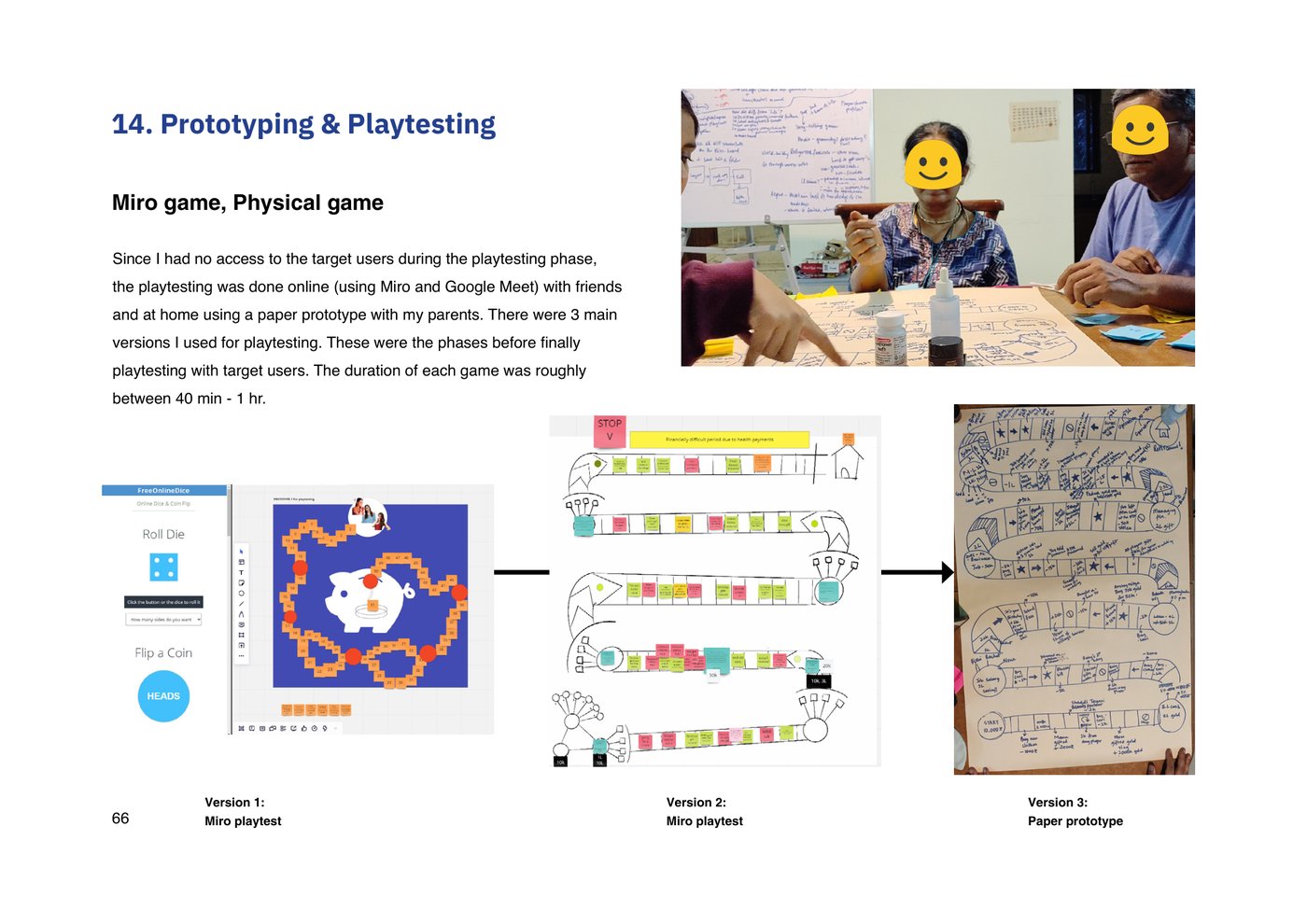
With little text, players couldn't anticipate what was coming; denominations were unpredictable; events in a cluster were uneven; a bottom-to-top path was too predictable.
Colour and number hints; levelled denominations; evened-out events; three new path shapes explored.
The board shows the player the path ahead, the principle behind the final layout.
Too many branches; players passive while the Game Master narrated; no player-to-player interaction; events were only about money.
Cut branching; added physical actions; added commodity exchange; added lose-a-turn style consequences.
The exchange mechanic produced the most entertaining moments in the target-user test.
What it became
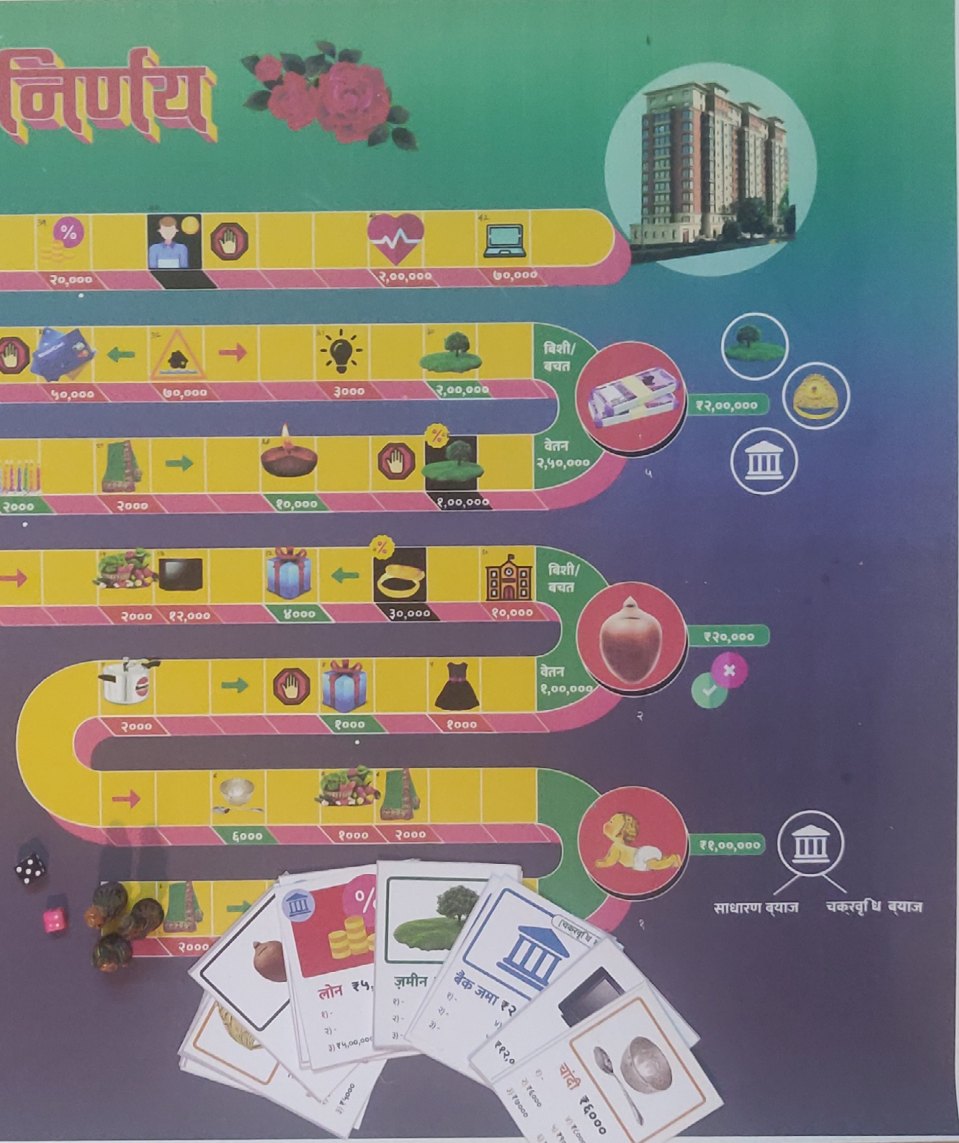
- Winding path, six red decision points, red (loss), green (gain) and black (opportunity) tiles
- Decision points are red regardless of outcome. I broke my own colour rule so the stops stand out.
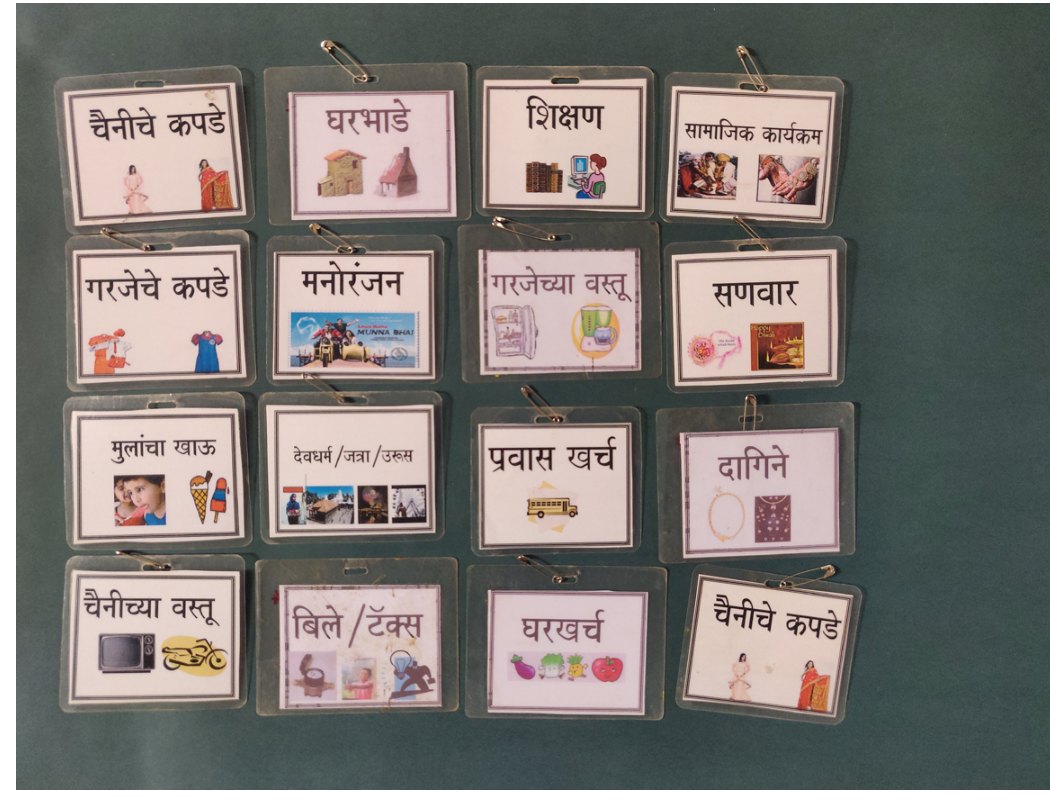
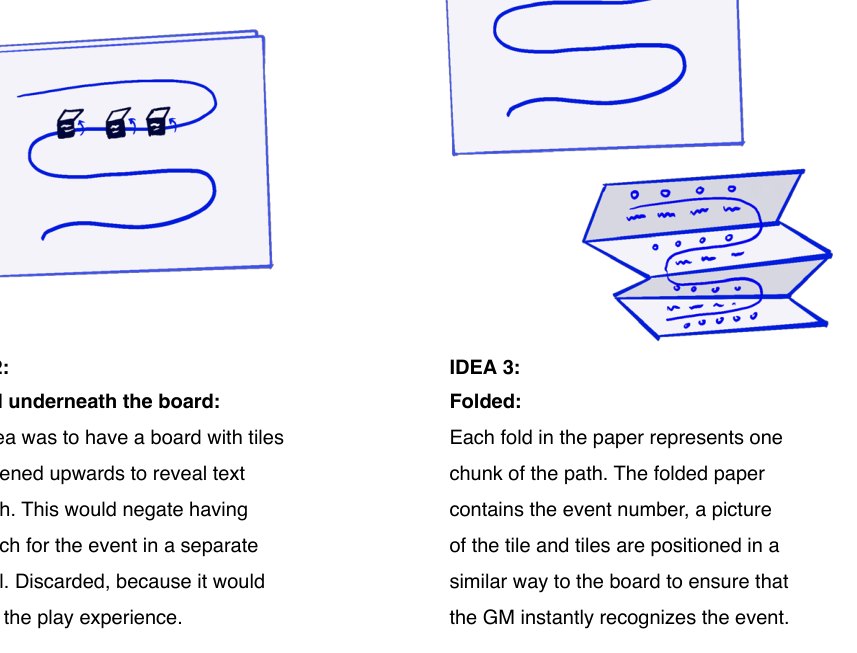
- Each fold matches one stretch of path, so the facilitator never hunts for a tile
- Hindi in a middle register: formal Hindi made the terms harder, "Bombay Hindi" read as fake
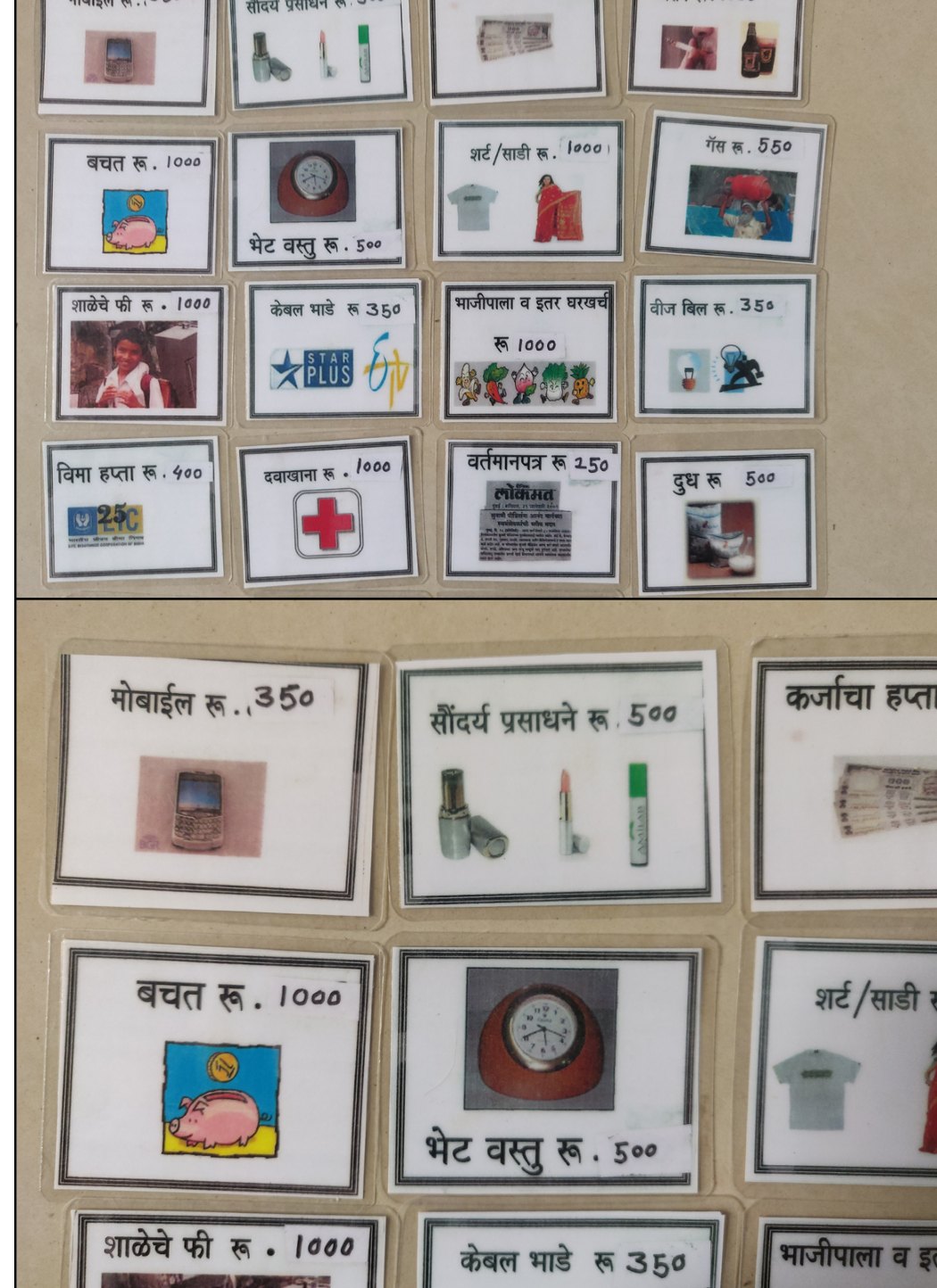
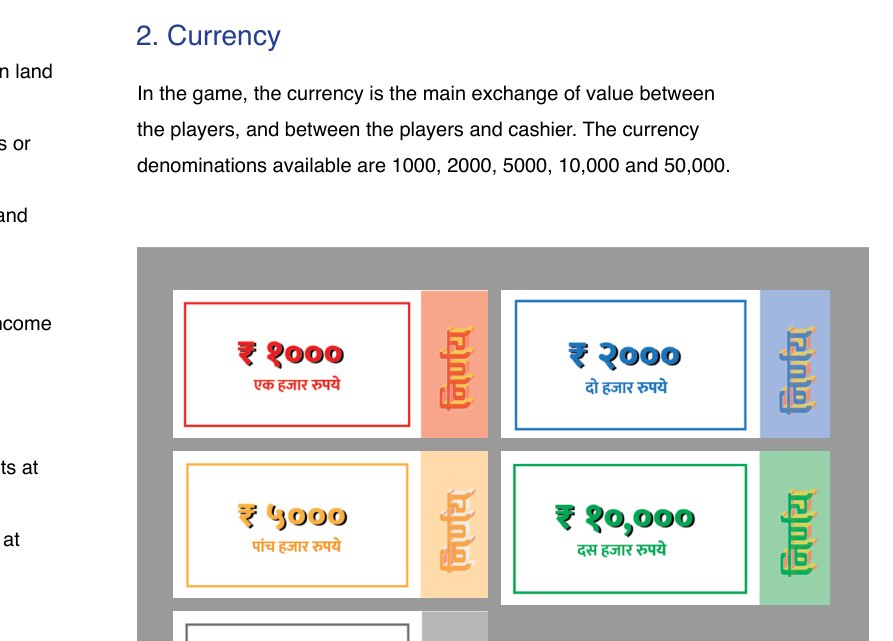
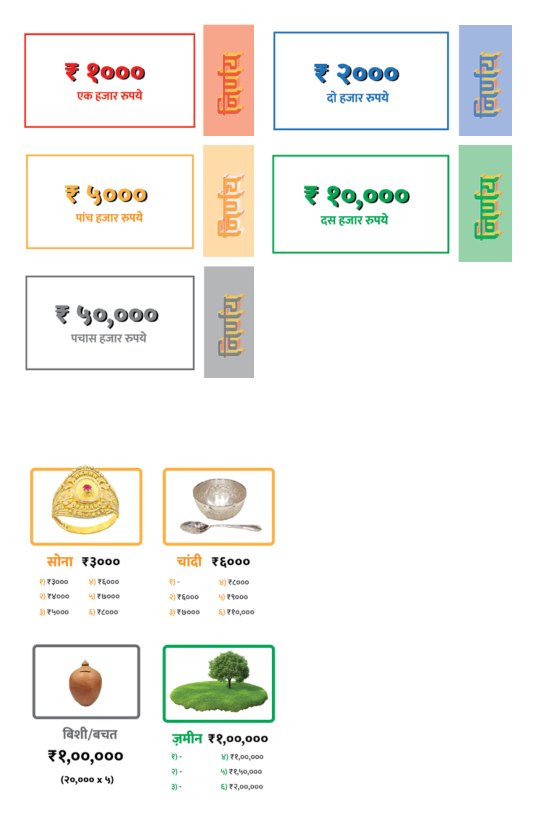
- Five denominations to 50,000, in real-currency proportions, because "a lakh never stays in one place" and handling big notes was aspirational
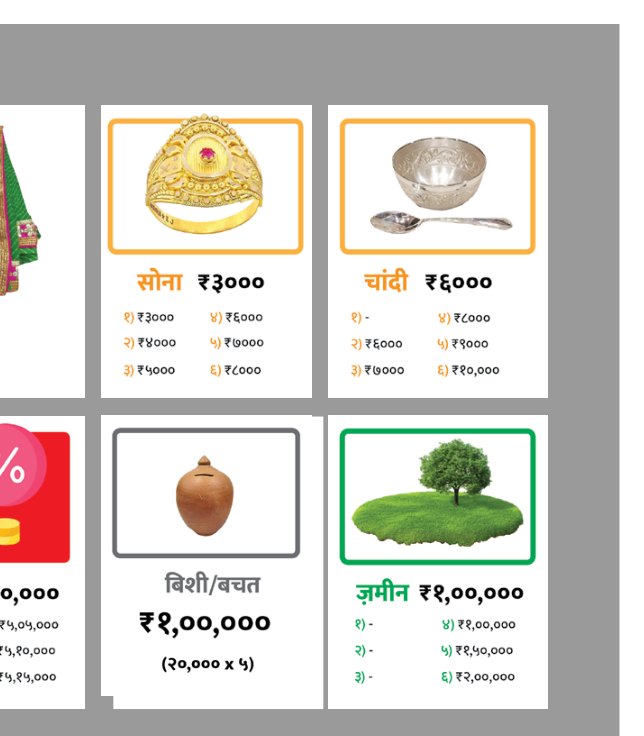
- Colour-coded for sorting without reading; seven asset types, most appreciating through the game
- Most money plus assets. Nobody retires with a loan outstanding; you go back and replay that decision.
What testing showed
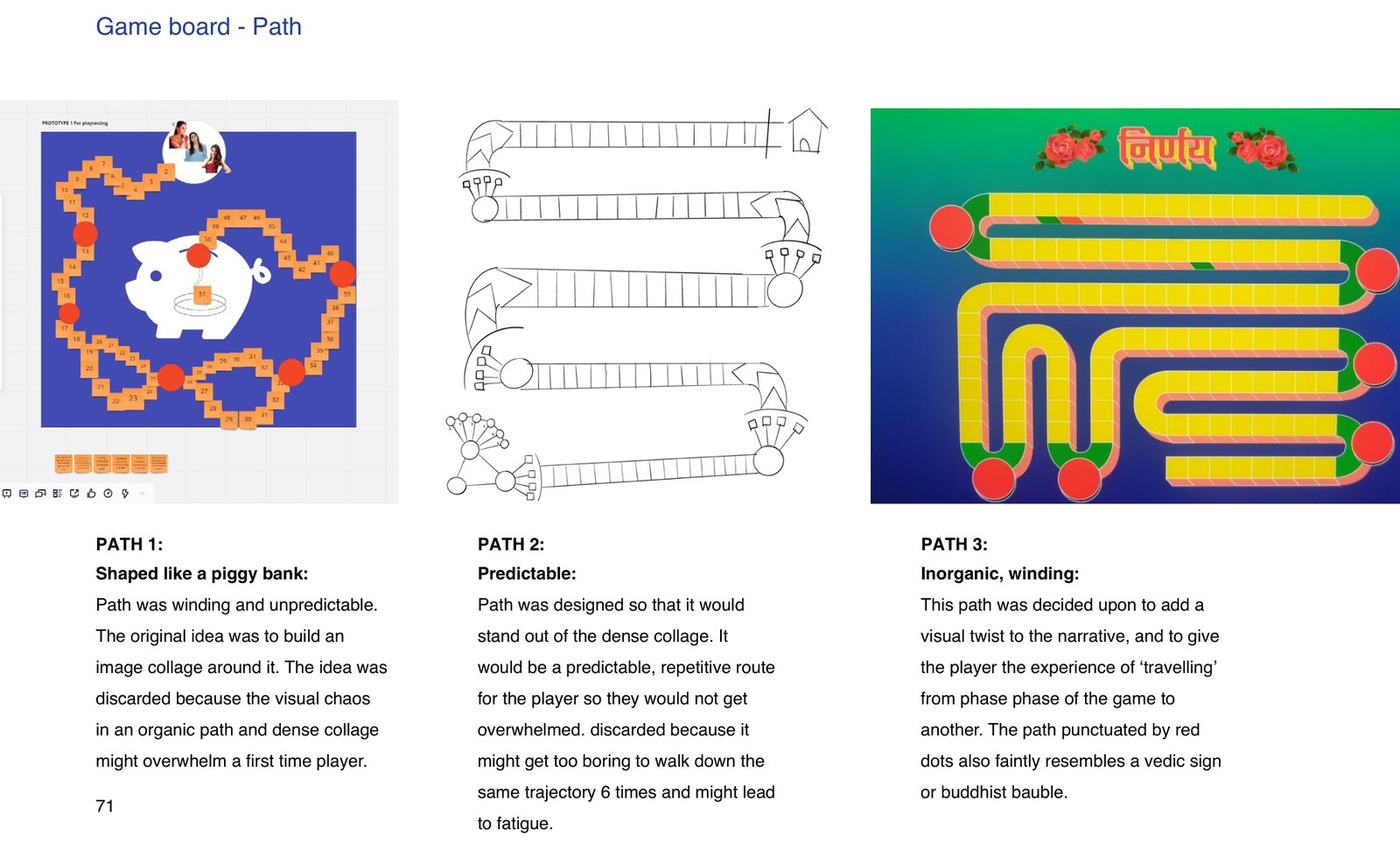
None of the three had played a board game before. The mechanics were clear within one or two turns, and each player found her own way through the material. The reader studied every card and sorted her currency. The numerate player handled money fluently and played entirely off the board. The non-literate player sorted nothing, followed the images and the Game Master's narration, needed help with payments, and won.
"Pehle kuch samajh mein nahi aaya, par jaise jaise khelne lage mujhe samajh mein aaya. Agli baar khelungi toh pata hoga kya karna hai."
"At first I didn't understand, but as we played I did. Next time I'll know exactly what to do." Player 1, after the session.
Against the criteria
- Content suitability and translation into play: five of the six concepts came back in the players' own words. Diversification: "I made a mistake there. I should have put money in three assets, not two." Annualisation: Player 1 explained why the bank loan beat the moneylender's monthly rate. Compounding: Player 3 knowingly took the "worse" savings option and reasoned that compounding on a loan is the danger, not the prize. Insurance: when the Game Master showed Player 1 she had profited by skipping it, she pushed back, "that was only a benefit by chance." Liquidity: a three-way discussion ended with land protecting money "for when you need it most" because it is hard to spend impulsively.
- Usability and aesthetics: all three called the plot, events and decisions easy to follow; the money figures were "very large" and took real effort. Green and red arrows were misread once and self-corrected. A Diwali lamp tile drew "gharaat deepawali aali", good fortune has entered your home, more cultural resonance than I had designed for.
- Suitability to the NGO's context and what players learned: all three wanted to play again. I put four questions to the NGO: is the game suitable to their context, where and how would it be used, what works and what doesn't, and what more is needed. Their answer was largely positive and they were looking forward to using it. They saw it opening up discussion, wanted it as an introduction and ice-breaker, and wanted to use it outside financial literacy in other sessions as well. They asked for three things: onboarding for new facilitators, a version prototyped in cloth and other materials, and fewer, smaller numbers and denominations in the game. The content expert's accuracy review was still pending at the final presentation on 23 June 2021. [[PLACEHOLDER: the content expert's feedback, if it came]]
My own verdict at the jury: it can teach new concepts and stay engaging, it explores an under-explored area, and it is more or less playable. What it still needed was fine-tuning and balancing for intuitiveness, facilitator onboarding, and work on translation and tone. The next steps I set were rigorous playtesting, a detailed manual, translation, and distribution across the NGO's centres.
What failed, and what I changed
The Bollywood-character pawns weren't available, so players played as themselves.
A noticeably tenser table when someone had to take a loan or take money from a friend, exactly what the pawns existed to buffer.
The emotional buffer is load-bearing. The pawns are not optional in the next print.
Nobody ever chose the risky business at decision point 4.
Winning needed a literal six; the odds read as discouraging entrepreneurship rather than weighing risk.
Rebalance the probability; the "either is valid" lesson did not land as designed.
Cards existed for a sari, a TV and a fridge, so players expected a card for every purchase.
An expectation the game could not meet.
Be consistent about what is collectible.
Player 1 asked why the Bishi and Bachat Gat paid no interest.
A content gap I had not modelled.
Unresolved in this version, and noted.
What one session cannot establish: retention, behaviour change, or how the game performs in the NGO's group setting. It ran in my home with people who knew me; novelty bias and the employer and employee dynamic are real confounds, and the report says so.
What I would do differently
Co-design with the players from the start. The pandemic made that impossible, and it shows in how much rests on six interviews. I also began this project believing my job was to diagnose problems and solve them. By the end I had moved to finding the one place a small, specific, playful intervention could sit. Not every problem here is a design problem. Knowing where to position the work was the design.